
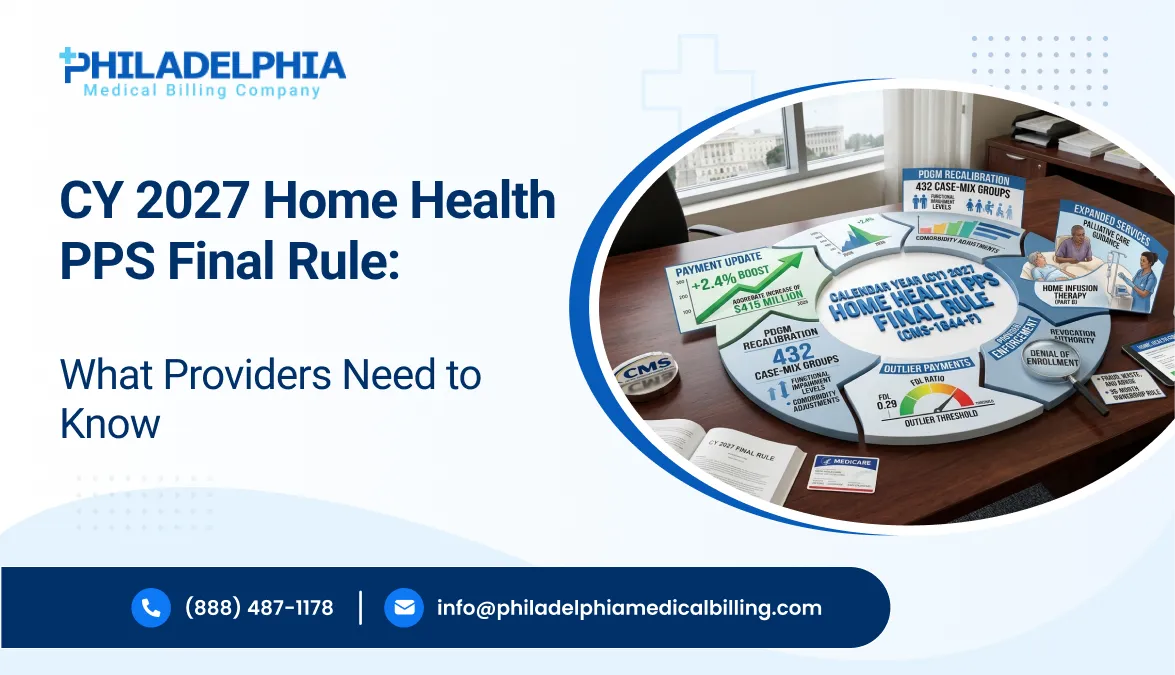
The CY 2027 Home Health PPS Final Rule will have significant impacts on Medicare payments, classification of patients, quality measures, and provider enrollment. It is necessary for home health agencies to know about the changes introduced by the rule considering the fact that they already struggle with increasing costs.
On November 4, 2026, CMS published Calendar Year 2027 Home Health Prospective Payment System Final Rule (CMS-1844-F). As per the agency, Medicare payments to home health agencies will grow by 2.4%, amounting to $415 million, as compared to 2026.
Yet, the rule is not just about increases in payment rates. In addition, it makes a 3% temporary payment update, adjusts Patient-Driven Groupings Model (PDGM) calculations, updates quality reporting requirements, and tightens Medicare enrollment oversight.
What should be done by providers, billing managers, and home health agency managers to ensure reimbursement protection and compliance for the year 2027?
The purpose of this guide is to explain the most important aspects of the final rule, its financial consequences, and actions that need to be taken prior to the start of the new payment year.
What Is the CY 2027 Home Health PPS Final Rule?
The Home Health Prospective Payment System (HH PPS) is the method that Medicare uses in determining payments to the eligible home health agencies that provide services to the beneficiaries who qualify for coverage under this program.
As opposed to paying for each individual routine service provided, Medicare uses the 30-day period of care as the payment unit under the Patient Driven Groupings Model.
CMS takes into consideration a number of factors in making calculations for the reimbursement such as those concerning the patient and his/her condition.
Every year, CMS evaluates Medicare claims and other pertinent information to make changes in payment rates and policies.
CY 2027 final rule brings about those changes and others that impact the provider enrollment process, quality reporting, and some services related to durable medical equipment.
Payment updates typically take effect from calendar year 2027 starting on January 1, although certain provisions within the rule can be effective on different dates.
CY 2027 Home Health PPS Final Rule: Key Changes at a Glance
The following table summarizes the most important finalized provisions.
|
Policy Area |
Finalized CY 2027 Update |
|---|---|
|
Estimated overall Medicare payments |
2.4% increase |
|
Estimated payment impact |
$415 million increase |
|
Home health payment update |
2.1%, approximately $365 million |
|
Outlier payment impact |
Additional estimated 0.3%, approximately $50 million |
|
Temporary payment adjustment |
-3.0% |
|
Additional permanent PDGM adjustment |
None finalized for CY 2027 |
|
Fixed-dollar loss (FDL) ratio |
0.29 |
|
PDGM case-mix weights |
Recalibrated using CY 2025 data |
|
LUPA thresholds |
Updated for CY 2027 |
|
OASIS reporting deadline |
Reduced from 135 to 45 days |
|
Medicare enrollment |
Expanded denial and revocation authorities |
|
Palliative care |
CMS addressed comments; future guidance anticipated |
|
Certain infusion pumps and drugs |
DME benefit expansion effective April 1, 2027 |
These changes will not affect every agency equally. Actual reimbursement depends on patient characteristics, coding accuracy, wage index values, and the services an agency provides.
1. Medicare Home Health Payments Will Increase by 2.4% in 2027
One of the most important points made in the final rule is the projected rise in overall home health payments made by Medicare.
According to CMS, there will be an increase of roughly $415 million in home health agency payments in CY 2027 when compared to CY 2026.
What Makes Up the Payment Increase?
CMS identifies two principal components of the estimated increase:
- 2.1% home health payment update: An estimated $365 million increase.
- 0.3% outlier payment impact: An estimated additional $50 million following the fixed-dollar loss update.
Together, these changes produce the estimated 2.4% overall increase.
However, providers should not interpret the national percentage as a guaranteed increase in their individual Medicare collections.
An agency that serves more medically complex patients may experience different payment changes than an agency with a larger proportion of lower-acuity cases.
Similarly, wage index adjustments, case-mix recalibration, LUPA thresholds, and patient utilization patterns can influence final reimbursement.
What providers should do: Compare expected 2027 payments with 2026 claims data rather than applying a flat 2.4% increase to projected revenue.
2. CMS Finalizes a 3% Temporary Payment Adjustment
However, despite the positive payment outlook, CMS will maintain the temporary reduction in regard to PDGM implementation.
The final CY 2027 rule reflects a temporary adjustment of -3.0% in the payment rate for the national standardized home health payments.
This adjustment reflects CMS’s statutory requirement to make the reconciliation of previous Medicare payments as they would be absent the behavioral changes among providers after implementing PDGM.
Why Is CMS Applying This Adjustment?
PDGM became the new system in 2020, adopting 30-day payment periods and grouping by patient characteristics.
At that time, CMS developed assumptions for the potential changes in agency coding and service delivery, among others.
In the long run, actual claims data differed from some of the assumptions made.
Under federal law, CMS is required to evaluate these differences and make any necessary adjustments to achieve budget neutrality.
For CY 2027, CMS has adopted an approach of recovering historical overpayments using a one-time adjustment.
It is important to mention that CMS did not adopt a permanent adjustment to the 2027 30-day base payment rate.
What Does the 3% Adjustment Mean for Agencies?
This reduction impacts how the payment rate is determined; however, it is not an automatic reduction of 3% in the total 2027 reimbursement for each agency.
There are other factors involved in the calculation of reimbursement payments.
Therefore, agencies need to consider the combined impact of the temporary reduction, PDGM recalibration, wage index changes, and patient mix.
3. PDGM Case-Mix Weights and LUPA Thresholds Are Changing
PDGM continues to be a significant tool in the reimbursement of home health agencies under the Medicare program for the year 2027.
PDGM enables CMS to categorize eligible 30-day periods into payment categories using several criteria including patient-related factors.
The PDGM has 432 payment categories with corresponding case-mix weights and LUPA thresholds.
For CY 2027, CMS set final case-mix weights, functional impairment, and comorbidity adjustment subgroup thresholds using CY 2025 utilization data.
How PDGM Affects Home Health Reimbursement
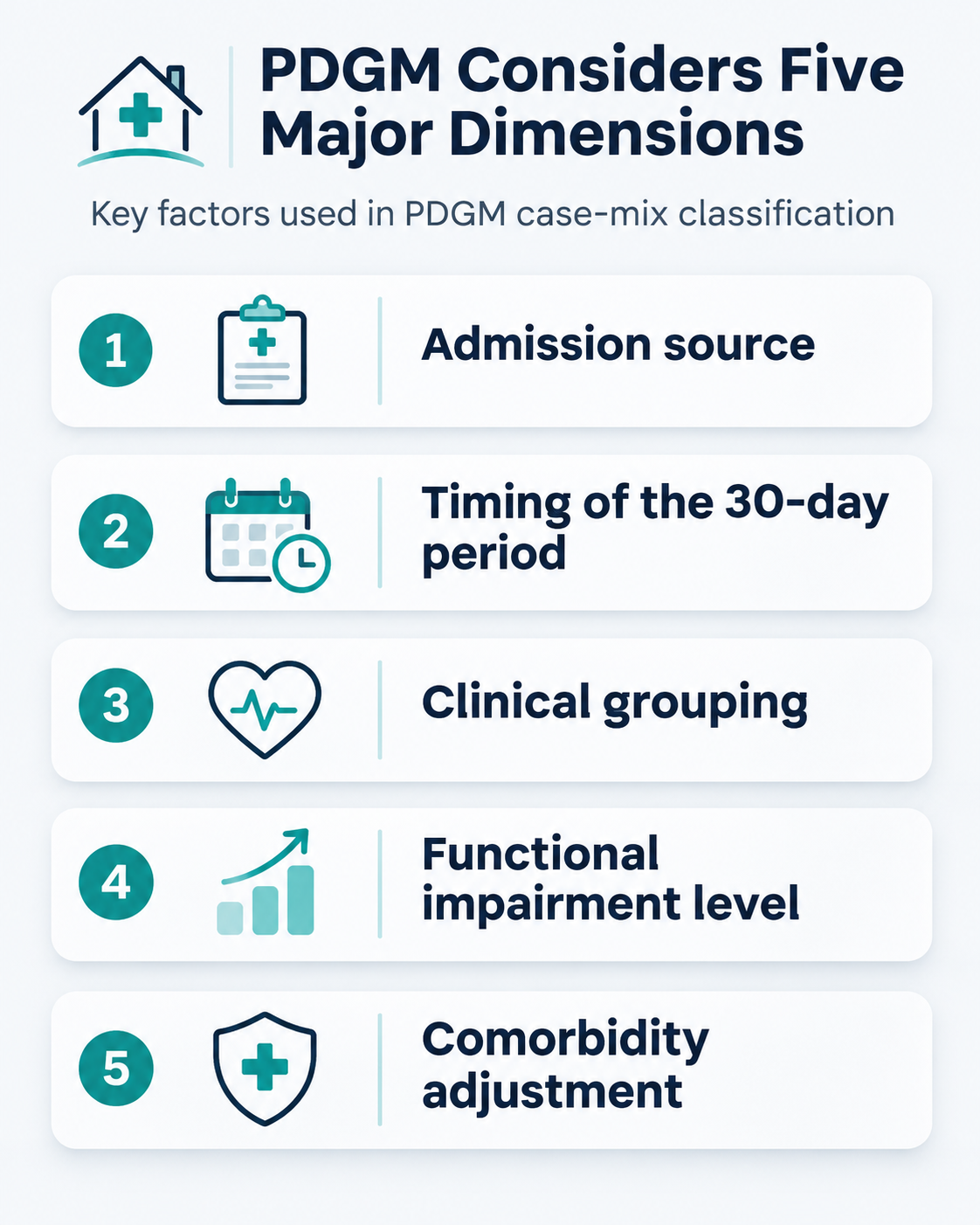
These factors contribute to the case-mix group that Medicare uses in its payment calculation.
Accurate diagnosis coding and comprehensive clinical documentation help agencies report patient characteristics correctly.
Why LUPA Thresholds Matter
This is referred to as LUPA, which occurs where the number of qualifying visits within 30 days is lower than the applicable threshold within PDGM.
Within the LUPA rule, the Medicare makes payments on a per visit basis instead of the total case-mix adjusted 30 days.
For instance, an agency may be expecting to receive the regular 30-day payment for a certain qualifying patient. This changes when the number of visits for the patient is below the applicable threshold.
As the LUPA threshold is reset annually by CMS, one should not rely on the last year’s threshold.
Practical suggestion: Update your billing system using the 2027 PDGM case-mix and LUPA files.
4. Home Health Outlier Payments Receive an Updated FDL Ratio
Some patients require unusually intensive or costly home healthcare services. Medicare’s outlier payment methodology helps account for qualifying periods with higher estimated costs.
For CY 2027, CMS finalized a fixed-dollar loss (FDL) ratio of 0.29.
The FDL calculation helps determine whether a 30-day period qualifies for an additional outlier payment. CMS uses estimated costs, the applicable payment amount, geographic wage adjustments, and other elements of the outlier methodology.
Importantly, outlier payments are not automatic simply because an agency delivers additional visits.
Agencies must satisfy the applicable payment criteria and submit accurate visit and claim information.
Why This Matters for Providers
Home health agencies that routinely provide services to complex patients must consider their prior outlier claims.
Estimating the cost of the services provided and comparing it to actual payments made by Medicare is one way to check the periods that need more scrutiny.
Proper reporting ensures proper payments. However, it must be noted that agencies must not increase visits just to be at the threshold of outliers.
5. OASIS Reporting Deadlines Will Become Shorter
The 2027 final rule for the calendar year also makes changes to the HH QRP program.
One significant amendment relates to the Outcome and Assessment Information Set (OASIS).
The OASIS submission deadline has been reduced from 135 days to 45 days. This is aimed at making home health care information available to Medicare beneficiaries.
As per the agency’s report, almost all of the agencies currently submit their OASIS data within 45 days. However, those who rely on late assessments and manual corrections will have to do something differently.
Additional Quality Reporting Updates
The final rule also:
- Aligns OASIS and Home Health Consumer Assessment of Healthcare Providers and Systems (HHCAHPS) annual payment update reporting timeframes with the January 1–December 31 calendar year.
- Updates assessment data submission deadlines beginning with the CY 2027 HH QRP program year.
- Improves digital information transfer during HH QRP compliance reconsiderations.
- Discusses advance care planning as a potential future quality measure concept.
What Agencies Should Do
Assess the process of assessing, submitting, and validating the assessments prior to 2027.
Cooperation between the clinical and administration team is required to determine any missing documents, fix data issues, and keep an eye on submission deadlines.
It is also necessary to differentiate the deadlines for submitting the assessment data from the clinical deadline for completion of assessments.
An effective OASIS process allows for proper quality reporting and eliminates the possibility of preventable compliance problems.
6. CMS Strengthens Medicare Provider Enrollment Requirements
The CY 2027 rule introduces important Medicare program integrity changes that extend beyond home health agencies.
CMS estimates that these broader enrollment changes could save taxpayers approximately $82 million annually.
A major provision allows Medicare enrollment revocations to take effect retroactively to the date noncompliance began, under the finalized revocation policy.
CMS also expands certain grounds for enrollment denial or revocation.
Ownership Changes Receive Greater Scrutiny
The final rule strengthens requirements involving certain changes in majority ownership.
Affected home health agencies, hospices, and DMEPOS suppliers may need to reenroll in Medicare as new providers and complete required surveys or accreditation.
Failure to meet applicable requirements may result in enrollment denial or revocation.
For home health organizations planning ownership transactions, this creates an important compliance consideration.
Before completing a qualifying transaction, administrators should review Medicare enrollment obligations and coordinate with appropriate legal and credentialing professionals.
Why Enrollment Compliance Matters
An enrollment issue can affect more than administrative standing.
Retroactive revocation may expose providers to repayment demands for Medicare payments associated with periods of noncompliance.
Therefore, agencies should keep enrollment records accurate, monitor ownership and management changes, and address licensing concerns promptly.
7. The Rule Addresses Palliative Care Under the Home Health Benefit
The final regulation also mentions access to community-based palliative care.
Palliative care consists of symptom relief and the improvement of quality of life for those suffering from any serious or chronic illness.
CMS specified that some palliative care services could be covered by Medicare’s current home health benefit if specific eligibility criteria are met.
However, the final rule does not establish a separate new Medicare home health palliative care benefit.
Eligibility continues to depend on Medicare home health requirements, the patient’s needs, and the services delivered.
CMS plans to provide additional examples through future guidance.
What This Means for Home Health Agencies
Healthcare organizations providing services to patients with severe conditions need to review their documentation process to ensure skilled symptom management and other covered services.
The medical record needs to show proof of medical necessity, patient eligibility, and services delivered.
There is a need for healthcare organizations to avoid confusing palliative care and hospice care because these are two different forms of service delivery.
8. Certain Home Infusion Pumps and Drugs Receive Expanded DME Coverage
The other important aspect concerns durable medical equipment and home infusion therapies.
Starting on April 1, 2027, CMS will be broadening the definition of the Medicare Part B DME category to cover specific infusion pumps and home infusion medications meeting certain statutory and regulatory criteria.
Such actions will result from implementation of provisions of the Consolidated Appropriations Act, 2026.
Among the qualifying conditions are FDA labeling requirements and conditions for administration/supervision by relevant healthcare professionals, as well as criteria of frequency of infusions.
9. What About Home Health Value-Based Purchasing in 2027?
The expanded Home Health Value-Based Purchasing (HHVBP) Model continues to influence home health agency operations.
The model links payment adjustments to performance under specified quality measures, encouraging participating agencies to improve patient outcomes and care quality.
Although CMS did not finalize new HHVBP-specific policy changes in this rule, it discussed potential alignment between HHVBP and the Home Health Quality Reporting Program.
Agencies should continue monitoring applicable quality measures, performance reports, and payment adjustment information.
In particular, care quality and financial performance should not operate as separate priorities.
Accurate assessments, coordinated care planning, and consistent documentation help support quality measurement and effective revenue cycle operations.
How Will the CY 2027 Home Health PPS Final Rule Affect Medical Billing?
The financial impact of the 2027 rule depends on more than the national payment update.
For billing professionals, the changes create several areas that deserve attention.
Accurate Primary Diagnosis Selection
The principal diagnosis contributes to PDGM clinical grouping.
Billing and coding teams must ensure that the reported diagnosis accurately reflects the condition chiefly responsible for the home healthcare services and follows applicable ICD-10-CM and PDGM coding guidance.
Incorrect diagnosis selection may affect grouping, reimbursement, and claim accuracy.
OASIS and Claims Documentation
OASIS assessments influence functional impairment classification, while diagnosis coding contributes to clinical grouping and comorbidity adjustments.
Inconsistent documentation can create discrepancies between the patient’s recorded clinical needs and reported payment information.
Agencies should coordinate clinical assessments, coding reviews, and billing validation to identify problems before claim submission.
LUPA Monitoring
Updated LUPA thresholds can affect payment classification.
Billing teams should monitor qualifying visit utilization, identify unexpected LUPA periods, and investigate discrepancies between authorized care plans, documented visits, and submitted claims.
Medicare Claims and Denial Management
Payment methodology changes can create additional administrative challenges when software settings or claim edits do not reflect updated requirements.
Common issues may include incorrect payment group assignments, incomplete documentation, missing visit information, and enrollment-related claim problems.
For home health providers in Pennsylvania, Philadelphia Medical Billing can support these administrative needs through medical billing, coding reviews, insurance claim management, and denial follow-up services.
A structured revenue cycle approach helps agencies identify discrepancies and maintain better visibility into unpaid claims.
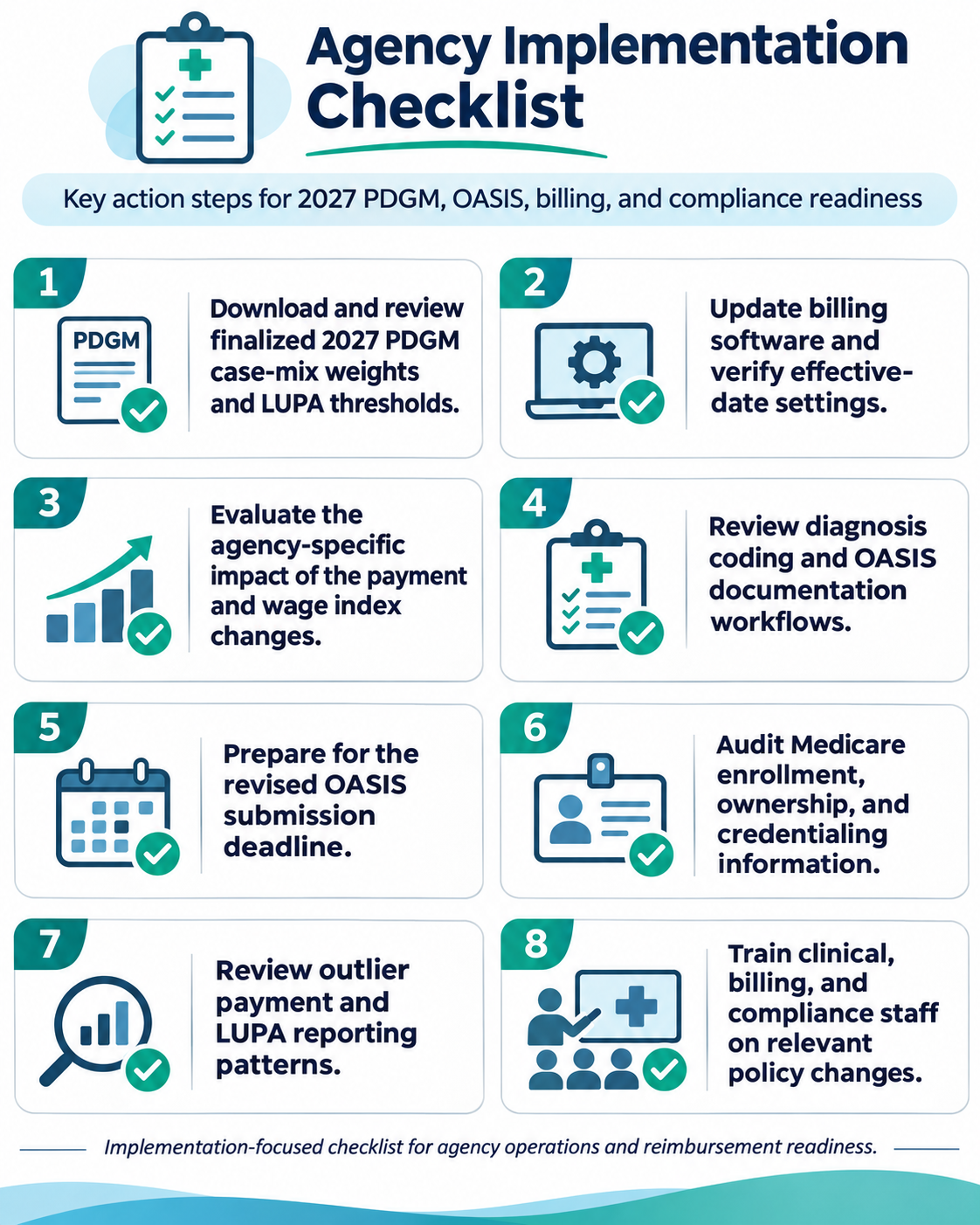
CY 2027 Home Health PPS Readiness Checklist
Home health administrators can use this checklist to organize preparation for the new payment year.
Frequently Asked Questions About the CY 2027 Home Health PPS Final Rule
1. What is the CY 2027 Home Health PPS Final Rule?
The CY 2027 Home Health PPS Final Rule is a CMS regulation that updates Medicare home health payment rates, PDGM case-mix calculations, LUPA thresholds, quality reporting requirements, and certain enrollment and DME policies for 2027.
2. How much will Medicare home health payments increase in 2027?
CMS estimates an overall 2.4% increase, representing approximately $415 million in additional Medicare payments compared with 2026. Actual payment changes will vary among agencies.
3. Did CMS finalize the 3% payment reduction for 2027?
Yes. CMS finalized a -3.0% temporary adjustment to the national standardized home health payment rate as part of its ongoing reconciliation of PDGM-related payments.
4. What are the new OASIS requirements for 2027?
CMS finalized a shorter OASIS data submission deadline of 45 days instead of 135 days. Agencies must also follow the updated HH QRP reporting requirements and applicable assessment instructions.
5. Are the PDGM and LUPA thresholds changing in 2027?
Yes. CMS recalibrated the PDGM case-mix weights, functional impairment levels, comorbidity adjustment subgroups, and LUPA thresholds using more recent utilization data.
6. Does the final rule introduce new palliative care coverage?
The rule discusses skilled palliative care available under the existing Medicare home health benefit. It does not establish a separate new benefit. Patients must continue meeting applicable Medicare home health coverage requirements.
7. When does the CY 2027 Home Health PPS Final Rule take effect?
The updated home health payment policies generally apply beginning January 1, 2027. Certain provisions have separate implementation dates, including the specified infusion pump and drug coverage expansion on April 1, 2027.
Conclusion
The CY 2027 Home Health PPS Final Rule presents both opportunities and responsibilities for Medicare-certified home health agencies.
Although CMS projects a 2.4% overall payment increase, providers must also prepare for the 3% temporary adjustment, revised PDGM calculations, updated LUPA thresholds, shorter OASIS reporting deadlines, and stronger Medicare enrollment oversight.
The most effective approach is to translate these regulatory changes into practical operational improvements. Agencies should review their billing systems, update documentation processes, evaluate reimbursement patterns, and ensure staff understand the requirements relevant to their responsibilities.
By preparing early and maintaining accurate clinical and financial records, home health providers can reduce avoidable billing problems and focus more resources on delivering reliable patient care.
Need Help Preparing Your Home Health Billing for 2027?
New Medicare payment policies, PDGM adjustments, LUPA thresholds, and documentation requirements can increase the administrative workload for home health agencies.
Philadelphia Medical Billing helps healthcare providers review coding accuracy, manage insurance claims, investigate denials, and maintain organized revenue cycle workflows.
Get support with your home health billing processes and prepare your practice for the upcoming Medicare payment changes.