

CD-10 Codes for Shoulder Pain depend upon the shoulder that is involved. Code M25.511 is used for pain in right shoulder, code M25.512 is used for left shoulder and code M25.519 is used for shoulder pain without any specific side mentioned.
Coding process not only requires knowing the shoulder involved but also consideration of other factors such as injuries, chronicity, etiology of pain and reason for encounter.
This guide provides information about shoulder pain ICD-10 Codes, coding examples, documentation guidelines and most common billing errors.
What Is the ICD-10 Code for Shoulder Pain?
The code for shoulder pain is M25.51 Pain in shoulder from subcategory M25.5 Pain in joint of ICD-10-CM.
These are the codes used when the physician reports shoulder pain with no further specific diagnosis.
|
ICD-10-CM code |
Description |
Billable |
|---|---|---|
|
M25.511 |
Pain in right shoulder |
Yes |
|
M25.512 |
Pain in left shoulder |
Yes |
|
M25.519 |
Pain in unspecified shoulder |
Yes |
|
M25.51 |
Pain in shoulder (subcategory) |
No |
These codes remain applicable under the FY2027 ICD-10-CM classification, effective October 1, 2026, through September 30, 2027. The CMS ICD-10 coding resources provide the official code files and reporting guidelines.
Important: Do not submit M25.51 as a diagnosis code on a claim. Select its appropriate billable child code instead.
Right Shoulder Pain ICD-10 Code: M25.511
M25.511 codes pain in the right shoulder if documentation supports such symptom.
The following coding guideline may be applied by practitioners when documenting pain in the right shoulder in an office visit, orthopedic consult, or any other appropriate encounter without a definite diagnosis established.
For instance, the patient complains of pain in the right shoulder when lifting items. However, the practitioner has not confirmed any rotator cuff tear or any other disease yet after examining the patient.
In this case, M25.511 may be a correct code to use according to the symptom documentation.
Left Shoulder Pain ICD-10 Code: M25.512
M25.512 pertains to left shoulder pain.
It is used if the provider notes pain in the left shoulder without identifying the underlying condition causing the pain.
A patient comes to an orthopedic clinic due to left shoulder pain. The provider notes pain but does not establish the cause of the pain, hence recommends more diagnostic tests. This may qualify M25.512 in that case.
In addition, it is important to note that the key element is laterality. The billing personnel must not confuse M25.511 and M25.512 since using the wrong laterality will result in a mismatch between the code and documentation.
Unspecified Shoulder Pain ICD-10 Code: M25.519
When it comes to shoulder pain, M25.519 is used where no side is indicated in the documentation.
While M25.519 is a legitimate billable code, physicians are encouraged to use laterality when possible.
For instance, in one encounter note, it is noted that shoulder pain was present but no side of the pain was indicated.
In this case, M25.519 could be used. However, if the affected side was indicated anywhere else in the documentation, it needs to be reviewed.
Better documentation supports more precise coding and reduces avoidable claim corrections.
What Is the ICD-10 Code for Bilateral Shoulder Pain?
When a patient experiences pain in both shoulders, providers should report the right and left shoulder codes separately.
ICD-10-CM does not provide a single bilateral code for shoulder joint pain.
|
Documented condition |
Appropriate ICD-10-CM code |
|---|---|
|
Right shoulder pain |
M25.511 |
|
Left shoulder pain |
M25.512 |
|
Bilateral shoulder pain |
M25.511 and M25.512 |
Example: There is a report of pain in the patient’s both shoulders during his/her physical therapy examination. However, the condition is not identified and described in the documentation.
The code can be M25.511 and M25.512 because of the provided information.
Using M25.519 does not consider the laterality detail.
Chronic Shoulder Pain ICD-10: When to Use G89.29
Chronic shoulder pain requires additional consideration because the duration and purpose of the encounter can affect diagnosis selection.
G89.29 (Other chronic pain) may be reported alongside the appropriate shoulder pain code when the documentation and coding guidelines support its use.
For example, the codes may include:
- M25.511: Right shoulder pain
- G89.29: Other chronic pain
However, G89.29 should not automatically accompany every shoulder pain diagnosis.
According to the FY2027 ICD-10-CM Official Guidelines, providers must document chronic pain, and the classification does not establish a universal time threshold for when pain becomes chronic.
Does Diagnosis Sequencing Matter?
Yes. The primary purpose of the encounter determines which diagnosis should appear first.
- Pain management encounter: An appropriate G89 code may be first-listed when the visit specifically focuses on pain control.
- Evaluation of shoulder pain: The site-specific shoulder pain code generally comes first when no definitive diagnosis has been established.
- Treatment of an established condition: The underlying diagnosis generally takes priority when treatment addresses that condition.
Coders should evaluate the entire encounter rather than select codes based only on how long the patient has experienced discomfort.
Shoulder Pain vs. an Underlying Diagnosis: Which Code Comes First?
One of the most critical aspects of shoulder pain coding is determining whether the diagnosis has been made with certainty by the physician.
Shoulder pain can be due to conditions like rotator cuff problems, bursitis, tendinitis, arthritis, or other musculoskeletal disorders.
After making sure of the condition causing the shoulder pain, the diagnosis usually comes before the symptom code.
The official CMS coding guidelines explain that providers should not routinely report symptoms separately when they are integral to a confirmed disease process.
Related Shoulder Conditions and ICD-10 Codes
The following examples illustrate how coding changes when a physician documents an established condition rather than shoulder pain alone.
|
Documented diagnosis |
ICD-10-CM code |
|---|---|
|
Adhesive capsulitis, right shoulder |
M75.01 |
|
Adhesive capsulitis, left shoulder |
M75.02 |
|
Shoulder impingement syndrome, right |
M75.41 |
|
Shoulder impingement syndrome, left |
M75.42 |
|
Bursitis, right shoulder |
M75.51 |
|
Bursitis, left shoulder |
M75.52 |
|
Bicipital tendinitis, right shoulder |
M75.21 |
|
Bicipital tendinitis, left shoulder |
M75.22 |
|
Unspecified nontraumatic rotator cuff tear, right shoulder |
M75.101 |
|
Unspecified nontraumatic rotator cuff tear, left shoulder |
M75.102 |
The above description is for a set of conditions under the ICD-10-CM codes M75. The provider needs to determine the particular condition before the coder codes the diagnosis.
Coding hint: The codes for a traumatic rotator cuff tear are different from those for a nontraumatic tear. You should not use the nontraumatic diagnosis code just because the patient has shoulder pain.
How to Code Shoulder Pain After an Injury
Shoulder pain that occurs after an injury, fall, or sports activity can be coded as one of the injury codes instead of using a code for joint pain.
The choice will depend on what the physician has diagnosed as the injury.
If a patient falls on his right shoulder and comes with pain and restricted movement, the doctor may diagnose the patient with a shoulder sprain, fracture, dislocation, or traumatic tendon injury.
What Should Providers Document?
Documentation for injury-related encounters should address:
- The affected shoulder and specific injury location.
- The type of injury established by the physician.
- How and when the injury occurred.
- Whether the encounter involves active treatment, subsequent care, or a sequela.
- Any additional conditions that affect treatment.
The presence of shoulder pain alone does not justify assigning a specific injury diagnosis without supporting documentation.
Shoulder Pain ICD-10 Coding: Practical Examples
The following scenarios show how the same symptom can lead to different coding decisions.
Scenario 1: Right shoulder pain without a confirmed diagnosis
A patient visits a primary care provider for right shoulder pain. The clinician performs an examination and orders imaging without establishing a definitive diagnosis.
Potential code: M25.511
Scenario 2: Bilateral shoulder discomfort
A physical therapist evaluates documented pain in both shoulders, with no established underlying diagnosis.
Potential codes: M25.511 and M25.512
Scenario 3: Confirmed frozen shoulder
An orthopedic physician diagnoses adhesive capsulitis of the left shoulder.
Potential code: M75.02
The confirmed diagnosis generally takes priority over a separate routine pain symptom code.
Scenario 4: Chronic pain management
A physician documents chronic right shoulder pain without a more definitive cause and provides a dedicated pain management service.
Potential codes: G89.29 and M25.511, with sequencing determined by the reason for the encounter.
These examples illustrate coding principles, not automatic code assignments. Final diagnosis selection must reflect the actual encounter and applicable coding requirements.
Documentation Requirements for Accurate Shoulder Pain Billing
Complete clinical documentation helps coding teams select the appropriate diagnosis and demonstrate why a service was necessary.
For shoulder pain encounters, providers should focus on five essential details.
1. Identify the Affected Shoulder
Always specify right, left, or bilateral involvement.
2. Document the Established Diagnosis
Record whether the encounter concerns unexplained shoulder pain or a confirmed musculoskeletal condition. Avoid adding unsupported diagnoses.
3. Describe the Relevant Symptoms
Include clinically relevant findings such as pain location, limited range of motion, weakness, or functional limitations when evaluated.
4. Clarify the Nature of Pain
If clinically established, document whether the pain is acute, chronic, traumatic, or related to a specific procedure.
5. Connect the Diagnosis to the Service
Ensure the documentation explains the clinical reason for the examination, imaging, physical therapy, injection, or other service performed.
Precise documentation helps practices support medical necessity and avoid inconsistencies during claim review.
Common Shoulder Pain ICD-10 Coding Mistakes
Even familiar diagnosis codes can create unnecessary billing work when documentation and claim information do not agree.
|
Common mistake |
Better coding approach |
|---|---|
|
Using M25.519 despite documented laterality |
Select M25.511 or M25.512 |
|
Reporting M25.51 on a claim |
Use a complete billable code |
|
Using one code for bilateral shoulder pain |
Report both applicable laterality codes |
|
Automatically adding G89.29 |
Confirm chronic pain documentation and coding relevance |
|
Coding only shoulder pain despite a confirmed underlying diagnosis |
Follow definitive diagnosis and symptom coding guidelines |
|
Assigning an injury diagnosis based on symptoms alone |
Obtain appropriate provider documentation |
|
Using the same diagnosis for every follow-up visit |
Review the current encounter and clinical assessment |
Practices can reduce repeat corrections by incorporating diagnosis checks into their medical coding workflow.
How Shoulder Pain Diagnosis Codes Affect Medical Billing
ICD-10-CM coding accuracy is crucial for demonstrating the medical necessity of shoulder services.
Nevertheless, the validity of an ICD-10 code alone does not assure that coverage will be provided or paid for.
It is possible that coverage criteria such as the relationship between diagnoses and procedures may need to be evaluated by payers.
Physical Therapy Billing
Physical therapy claims may require documentation regarding the patient’s condition, limitations, treatment goals, and services provided.
It is important to make sure that the diagnosis properly identifies the problem that is being treated.
Diagnostic Imaging
X-ray of shoulder joint, MRI scans and similar imaging studies need justification.
Proper assessment of shoulder pain confirms the necessity of imaging test, however, certain guidelines regarding medical necessity based on payers’ criteria should be met.
Orthopedic Procedures and Injections
In cases where the physician injects therapeutic medication or performs other orthopedic procedures, it is important to consider the existing diagnosis, procedure done, and payer policies.
Other procedures may need prior authorization.
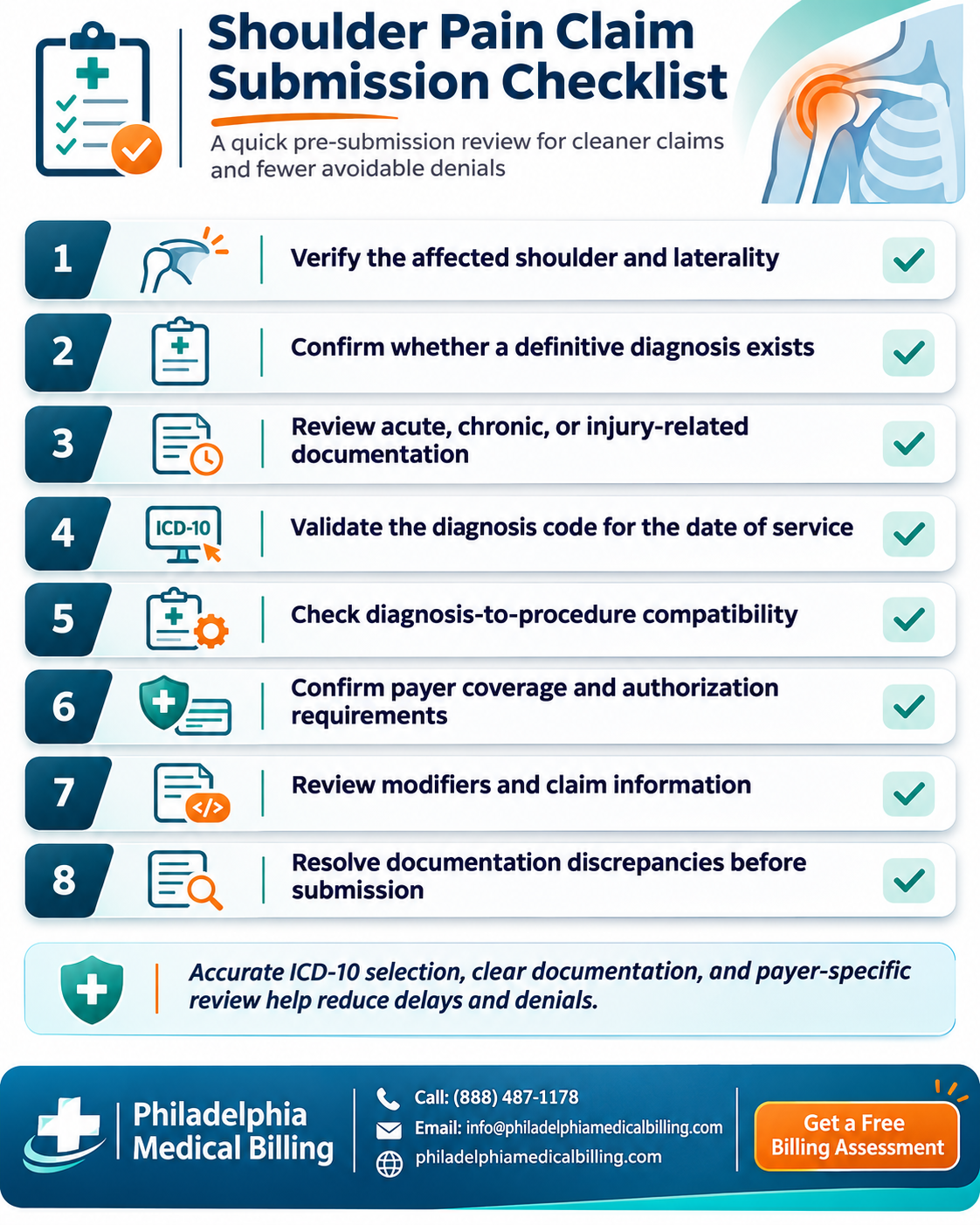
A Quick Pre-Submission Checklist for Shoulder Pain Claims
Before submitting a shoulder-related claim, billing teams can use this checklist to identify avoidable errors.
Make Every Shoulder Pain Claim Count
Shoulder-related encounters can involve imaging, therapy, injections, orthopedic procedures, and follow-up care. Each stage creates coding and billing responsibilities that demand accurate information.
Philadelphia Medical Billing provides orthopedic medical billing and coding services to help practices manage diagnosis coding, claims submission, insurance verification, and denial follow-up.
Our billing support focuses on helping providers:
- Identify diagnosis and documentation inconsistencies before submission.
- Manage orthopedic and physical therapy-related billing workflows.
- Address coding-related claim rejections and denials.
- Track outstanding insurance claims and follow-up requirements.
- Reduce administrative work that takes time away from clinical operations.
Whether your practice handles routine shoulder pain evaluations or complex orthopedic procedures, a consistent billing process helps protect revenue and improve claim accuracy.
Your Shoulder Pain Claims Deserve More Than Guesswork
Reduce preventable coding errors, simplify orthopedic claims, and strengthen denial follow-up with billing support tailored to your practice.
Frequently Asked Questions About Shoulder Pain ICD-10 Codes
ICD-10 code for right shoulder pain?
The right shoulder pain ICD-10-CM code is M25.511. This is when the physician or other providers describe right shoulder pain but do not have any other specific diagnosis to explain the pain.
ICD-10 code for left shoulder pain?
The left shoulder pain ICD-10 code is M25.512. This is a billable diagnosis code that can be applied to the described documentation of left shoulder pain.
ICD-10 code for bilateral shoulder pain?
In case of bilateral shoulder pain, one needs to use the codes M25.511 for right shoulder and M25.512 for the left shoulder.
What is the code for chronic shoulder pain under the ICD-10?
The shoulder pain code will indicate whether the pain occurs in the right or left shoulder. G89.29 may be appropriate for other chronic pain when medical records and coding rules warrant its selection. The sequence of the diagnosis is based on the reason for the visit.
Is M25.519 a code for unspecified shoulder pain?
Yes. This code is a billable medical code for pain in the shoulder unspecified. It should be selected where laterality cannot be determined based on documentation provided.
Should shoulder pain be listed separately with a rotator cuff tear?
No. Where the doctor diagnoses a rotator cuff tear, and the pain is an associated symptom of the condition, the latter usually takes precedence over shoulder pain.
Final Thoughts
Choosing the appropriate ICD-10 code for shoulder pain begins with proper documentation and laterality determination.
The M25.511 code indicates pain in the right shoulder, the M25.512 code indicates pain in the left shoulder, while the M25.519 code is used in cases where the side is not specified. There might be a need for alternative coding in cases of chronic pain, injuries, or an underlying disease that has been determined.
From the perspective of health care practitioners, the objective goes beyond choosing a legitimate diagnostic code. A standardized process of documentation, coding, and claim submission can avoid potential billing issues.