
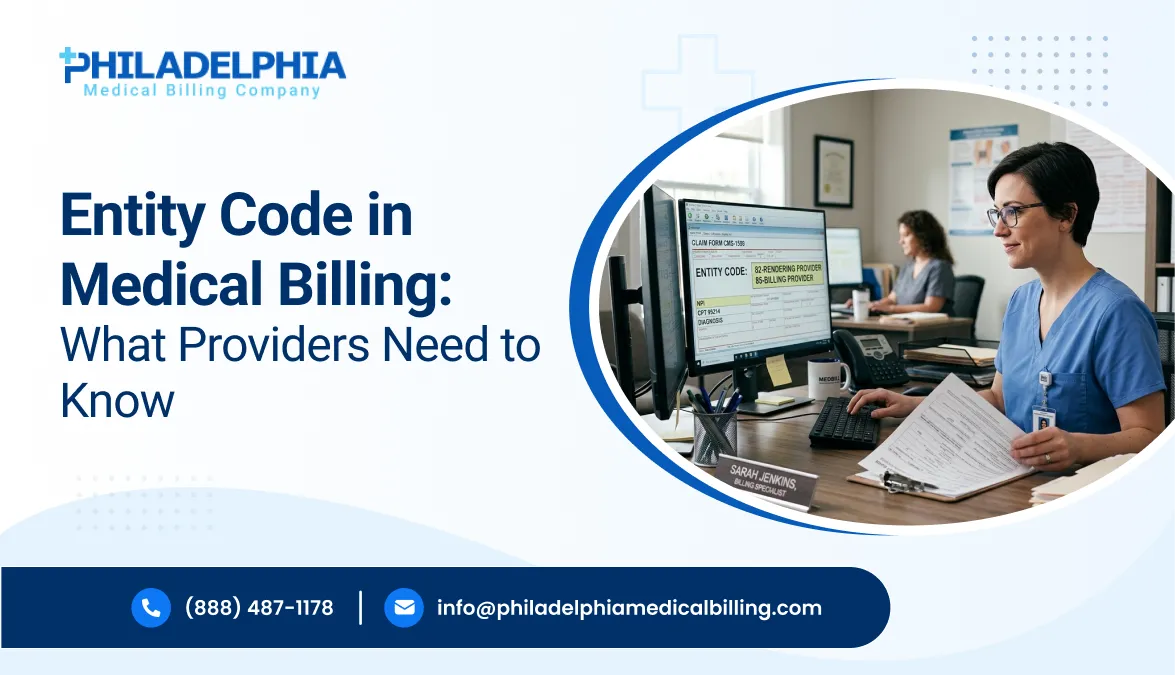
Electronic claims contain hundreds of data points, and some of the smallest fields can create surprisingly large reimbursement problems. An entity code in medical billing is one of those details.
Providers may first encounter an entity code when a claim is rejected with a message such as “this code requires use of an entity code,” “entity’s specialty/taxonomy code,” or another claim-status response that identifies a problem with the billing, rendering, referring, or other provider.
These messages might seem confusing because an entity code is not the same, as an NPI or a taxonomy code or a CPT code or an ICD-10-CM code or a modifier. Instead it helps an electronic healthcare transaction figure out which person or organization a certain data element is linked to.
Understanding that distinction can make provider-related claim rejections much easier to investigate and correct.
What Is an Entity Code in Medical Billing?
An entity code in billing is a type of identifier used in electronic healthcare transactions. It helps show the role of a person or organization involved in a claim or a claim-status message.
For instance in a transaction it might be important to tell the difference, between the doctor who did the service and the medical practice or organization that sent the claim. The entity code makes this clear.
CMS documentation provides examples such as:
| Entity Code | Entity Role |
|---|---|
| 82 | Rendering Provider |
| 85 | Billing Provider |
| 71 | Attending Physician |
The exact entity codes used depend on the transaction and applicable implementation requirements.
For instance, CMS documentation for claim-status transactions identifies 85 as the billing provider. CMS also documents claim-status responses in which 82 identifies the rendering provider.
The important point is simple:
The NPI identifies the provider. The entity code identifies the provider’s role within that particular electronic transaction.
That difference explains why the same physician or organization might look different depending on the role it is playing—whether it is the rendering provider, billing provider referring provider attending provider or another type of entity. Each role has its function and that affects how it shows up in records or claims. It’s not that the person or organization is different. It’s just that the way they are listed changes based on what they’re doing in the process.
Why Entity Codes Matter on Healthcare Claims
A payer cannot process an electronic claim correctly unless it can determine who performed the service, who submitted the claim, and which provider information belongs to each role.
Healthcare claims may contain information for several parties, including the:
- billing provider
- rendering provider
- referring or ordering provider
- attending provider
- service facility
- patient
- subscriber
- payer
Entity identifiers help electronic systems match each piece of information to the person or organization.
This matters a lot when a medical practice uses a NPI but individual doctors bill using their own rendering NPIs.
If a Physicians details end up in the billing-provider field. If the organization’s details go in the rendering provider spot the treatment might be correct and the service valid.. The electronic claim can still be rejected. That’s because the system looks at the wrong provider information.
Entity Code vs. Taxonomy Code
Another common source of confusion is the healthcare provider taxonomy code.
A taxonomy code is a way to show what kind of healthcare provider someone is. CMS says taxonomy codes are 10-character codes used to show provider classification and area of expertise when applying for an NPI.
For example a taxonomy code might show that a provider is a family medicine physician, a cardiologist, a physical therapist, a behavioral health professional or another type of provider.
An entity code answers:
“Which provider or party are we talking about?”
A taxonomy code answers:
“What type or specialty of provider is this?”
These two pieces of information can appear together in a rejection.
For example X12 Claim Status Code 145 means that an entity’s specialty or taxonomy code is involved. This code requires an entity code so the receiver can figure out which entity’s taxonomy information has an issue.
Therefore, a response involving:
145 + 82
points toward the taxonomy information associated with the rendering provider.
CMS documentation specifically shows a 277 claim-status edit in which Claim Status Code 145 relates to the provider taxonomy and Entity Identifier Code 82 identifies the rendering provider.
This is much more useful than treating “145” as a standalone denial code.
Understanding the A3/145/82 Claim Rejection
One entity-code combination providers may encounter is:
A3 / 145 / 82
These components perform different functions.
A3 is a Claim Status Category Code. X12 defines A3 as a claim that has been returned as unprocessable and has not entered the adjudication system.
145 refers to the entity’s specialty or taxonomy code.
82 identifies the rendering provider.
Together, the message generally indicates that the claim cannot move forward because of taxonomy-related information associated with the rendering provider.
Possible causes can include:
- missing rendering-provider taxonomy information
- an incorrect taxonomy code
- a taxonomy that does not match the provider’s enrollment record
- an incorrect rendering-provider NPI
- provider information mapped to the wrong claim loop
- payer-specific provider enrollment requirements
The correction should be based on the actual payer or clearinghouse response rather than simply changing codes until the claim passes.
Understanding A3/145/85
A similar response may include:
A3 / 145 / 85
Here, the entity code changes from 82, the rendering provider, to 85, the billing provider.
That tells you where to focus the investigation.
Instead of immediately reviewing the individual rendering physician, verify the billing provider’s taxonomy, NPI, enrollment information, and claim configuration.
That single entity-code difference can save a provider’s office from troubleshooting the wrong record.
Entity Codes and the 277CA Claim Acknowledgment
Entity-code errors frequently appear during electronic claim acknowledgment rather than after full payer adjudication.
The 277CA Health Care Claim Acknowledgment is one of the standard electronic transactions used in healthcare claims processing. CMS identifies the 277CA as the transaction used for health care claim acknowledgment, while other transactions include the 837P for professional claims, 276/277 for claim status, and 835 for payment or remittance information.
This distinction matters because a rejected claim may never enter the payer’s adjudication system.
In practical terms:
Rejection: Something prevented the claim from entering normal adjudication.
Denial: The payer processed the claim but determined that all or part of it would not be paid.
Providers should therefore avoid treating every entity-related message as a traditional denial.
If a 277CA says the claim was returned as unprocessable, correcting and resubmitting the claim may be appropriate. The exact resubmission process should always follow payer and clearinghouse instructions.
Common Reasons for Entity Code Rejections
Entity-code problems rarely begin with the entity code itself. More often, the entity code tells you which party has another data problem.
Incorrect Rendering Provider Information
A professional claim may contain the correct billing organization but an incorrect or missing rendering-provider NPI.
Verify the individual who actually performed the service and confirm that the information transmitted on the 837P matches the provider’s payer enrollment.
Billing Provider Information Does Not Match Enrollment
The NPI may be valid but associated information such as the organization name, tax ID, address, or taxonomy may not match the payer’s records.
CMS documentation shows that electronic claim edits can validate relationships between provider identifiers and other billing-provider data.
Taxonomy Code Errors
A taxonomy can be technically valid but still inappropriate for the provider, specialty, payer contract, or submitted claim.
Providers can use the NUCC taxonomy code set when reviewing their classification. CMS specifically directs providers to the NUCC code set for selecting the taxonomy that best describes their classification or specialization.
Rendering and Billing Providers Are Reversed
This can happen after:
- onboarding a new provider
- changing clearinghouses
- migrating practice-management software
- adding a new location
- modifying provider templates
- updating payer enrollment
A practice configuration error may repeatedly generate the wrong electronic claim structure even when staff members enter the patient’s visit correctly.
Referring or Ordering Provider Problems
Certain services require ordering or referring provider information.
If that provider’s name, identifier, taxonomy, or enrollment status is incorrect, the claim may generate a provider-entity error even though the billing and rendering provider information is correct.
Service Facility Information Is Incorrect
Claims performed at locations different from the billing provider’s primary address may require appropriate service-facility information.
An incorrect service location, identifier, or address can therefore create another provider/entity-related issue.
Does an Entity Code Have an ICD-10-CM Code?
No.
There is no ICD-10-CM diagnosis code specifically for an entity-code error.
ICD-10-CM codes describe diagnoses, diseases, symptoms, injuries, and other health conditions. Entity codes describe parties or roles within electronic administrative transactions.
For example, a claim might contain:
ICD-10-CM: E11.9 — Type 2 diabetes mellitus without complications
CPT: 99213 — Established patient office/outpatient E/M service
Rendering provider: Individual physician
Billing provider: Physician group
If an entity-code rejection occurs, changing E11.9 would generally make no sense unless the payer separately identified a diagnosis problem.
The provider should correct the entity-related information rather than altering an otherwise accurate clinical diagnosis merely to obtain payment.
Are CPT or HCPCS Codes Associated With Entity Codes?
Entity codes do not have corresponding CPT or HCPCS procedure codes.
CPT and HCPCS codes identify the service, procedure, supply, or item being billed.
An entity identifier tells the payer who or what party is associated with claim information.
For example:
| Claim Element | Example | Purpose |
|---|---|---|
| ICD-10-CM | E11.9 | Identifies the diagnosis |
| CPT | 99213 | Identifies the professional service |
| HCPCS | J-code when applicable | Identifies certain drugs/services/supplies |
| NPI | 10-digit provider identifier | Identifies the provider |
| Taxonomy | 10-character code | Identifies provider classification/specialty |
| Entity code | Example: 82 or 85 | Identifies the party’s role |
| Modifier | 25, 26, TC, 59, etc., when appropriate | Adds information about the service |
These coding systems work together on the claim, but they serve completely different purposes.
Do Modifiers Affect Entity Code Errors?
Usually not directly.
Modifiers such as 25, 26, TC, 59, XE, XP, XS, or XU provide additional information about a service or procedure. They do not identify whether an NPI belongs to the rendering provider or billing provider.
However, modifier use and provider-role information can occasionally intersect operationally.
For instance, professional and technical components of certain diagnostic services may involve different billing arrangements. Modifier 26 identifies the professional component, while TC identifies the technical component when their use is appropriate under the applicable CPT and payer rules.
The provider information on those claims must still accurately identify the party performing or billing each component.
The important rule is to avoid adding or changing a modifier simply because the claim contains an entity-code rejection. Correct the actual data problem identified by the claim response.
Relevant Claim Status Codes
Entity codes are frequently paired with Claim Status Codes.
Some examples from the X12 claim-status code set include:
| Claim Status Code | Meaning |
|---|---|
| 73 | Payment made to entity; assignment of benefits not on file |
| 85 | Entity not primary |
| 88 | Entity not eligible for benefits for submitted dates |
| 135 | Entity’s commercial provider ID |
| 136 | Entity’s health industry ID number |
| 138 | Entity’s site ID |
| 142 | Entity’s license/certification number |
| 143 | Entity’s state license number |
| 145 | Entity’s specialty/taxonomy code |
| 149 | Entity’s employer ID |
| 153 | Entity’s ID number |
| 155 | Entity’s relationship to patient |
Several of these codes specifically require an Entity Code because the receiver needs to know which entity the message refers to.
Providers should read the entire response combination rather than interpreting the status code in isolation.
Relevant Remittance Advice Remark Codes
When a claim progresses further into adjudication, provider-identifier problems may also appear through Remittance Advice Remark Codes (RARCs).
Relevant examples include:
N257 — Missing/incomplete/invalid billing provider/supplier primary identifier
N258 — Missing/incomplete/invalid billing provider/supplier address
N264 — Missing/incomplete/invalid ordering provider name
N265 — Missing/incomplete/invalid ordering provider primary identifier
N284 — Missing/incomplete/invalid referring provider taxonomy
N285 — Missing/incomplete/invalid referring provider name
N286 — Missing/incomplete/invalid referring provider primary identifier
N288 — Missing/incomplete/invalid rendering provider taxonomy
N289 — Missing/incomplete/invalid rendering provider name
N290 — Missing/incomplete/invalid rendering provider primary identifier
N292 — Missing/incomplete/invalid service facility name
N293 — Missing/incomplete/invalid service facility primary identifier
N294 — Missing/incomplete/invalid service facility primary address
N296 — Missing/incomplete/invalid supervising provider name
N297 — Missing/incomplete/invalid supervising provider primary identifier
X12 explains that RARCs provide additional information about adjustments or remittance processing.
The presence of one of these remark codes does not automatically mean that an entity-code error caused the claim problem. It does, however, help identify exactly which provider or facility data needs review.
Providers should also remember that code sets are periodically updated. X12 lists updates during 2026, including changes affecting remittance-advice and other healthcare transaction code sets.
What About CARC Codes?
Claim Adjustment Reason Codes (CARCs) explain financial adjustments made during claim adjudication.
They should not be confused with 277CA claim-status category codes.
For example, A3 in a claim-status response means the claim was returned as unprocessable. That is different from seeing similarly formatted codes in another transaction.
This is why providers should first determine whether they are looking at:
- a clearinghouse rejection
- 277CA acknowledgment
- payer claim-status response
- electronic remittance advice
- explanation of benefits
Only then should the associated codes be interpreted.
Using the right code set prevents unnecessary corrections to diagnoses or procedures that were never the source of the problem.
How Providers Can Fix an Entity Code Rejection
The safest way to resolve an entity-code rejection is to follow the claim data from the error message back to the provider record.
Start with the complete rejection message rather than one code.
If the message identifies 82, review the rendering provider.
If it identifies 85, review the billing provider.
If Claim Status Code 145 accompanies it, inspect the taxonomy information for that specific provider role.
Then verify:
- The provider’s NPI in NPPES.
- The correct individual or organizational provider record.
- The taxonomy associated with the provider.
- Payer enrollment and credentialing records.
- Billing-provider and rendering-provider relationships.
- Tax ID and organization information where applicable.
- Service location details.
- Claim-loop mapping within the practice-management or clearinghouse system.
- Payer-specific companion-guide requirements.
CMS states that providers must select a healthcare provider taxonomy code when applying for an NPI and directs providers to the NUCC taxonomy code set.
The information submitted on the claim should also agree with the payer’s enrollment records.
An Example of Troubleshooting an Entity Code Error
Consider a physician group that submits a claim for an established patient visit.
The clinical information is:
CPT: 99213
ICD-10-CM: E11.9
Billing provider: ABC Medical Group
Rendering provider: Dr. Jones
The clearinghouse returns:
A3 / 145 / 82
Changing CPT 99213 would not address this message.
Changing E11.9 would not address it either.
The response points toward the rendering provider because 82 identifies that entity, while 145 points toward specialty/taxonomy information.
The practice should therefore review Dr. Jones’s rendering NPI, taxonomy, payer enrollment, and electronic claim mapping.
If the provider recently changed specialties, locations, groups, or enrollment information, that should also be investigated.
This targeted approach is far more efficient than making unrelated coding changes.
Preventing Entity Code Problems Before Claims Are Submitted
Providers can reduce entity-related claim rejections by keeping enrollment and claim-system information synchronized.
Whenever a new physician joins a practice or a facility opens a new location, confirm that the provider data entered into the EHR, practice-management platform, clearinghouse, and payer enrollment systems match.
Taxonomy deserves particular attention.
A provider may have multiple taxonomy codes in NPPES, but individual payers can have their own enrollment and claim-submission requirements. The taxonomy transmitted on the claim should therefore reflect both the provider’s actual classification and applicable payer requirements.
Periodic audits are also useful after:
- credentialing changes
- provider onboarding
- mergers or acquisitions
- ownership changes
- practice relocations
- new specialty additions
- clearinghouse changes
- EHR or billing-platform migrations
Small configuration problems introduced during these transitions can affect hundreds of claims before anyone notices a pattern.
Why Provider Enrollment and Entity Information Must Match
Claim submission and provider enrollment are closely connected.
A payer may recognize a physician’s NPI but not recognize that physician as affiliated with the group submitting the claim. Another payer may have the provider enrolled under a different location or taxonomy.
Therefore, verifying that an NPI exists is only the beginning.
The provider’s enrollment relationship, specialty, practice information, and applicable identifiers may all need to align with the claim.
For practices dealing with repeated provider-identification or taxonomy rejections, Philadelphia Medical Billing can help review claim configuration, payer enrollment information, and recurring rejection patterns so the underlying issue can be addressed instead of repeatedly correcting individual claims.
Entity Code Errors Should Not Lead to Unnecessary Clinical Coding Changes
One of the biggest mistakes providers can make is changing valid clinical codes in response to an administrative rejection.
If the diagnosis is accurately documented and correctly represented by ICD-10-CM, it should not be replaced simply because a clearinghouse rejects the rendering-provider taxonomy.
Similarly, a correctly selected CPT or HCPCS code should not be changed merely to bypass a provider enrollment problem.
Each part of the claim should be corrected based on the actual error.
Clinical coding should reflect the patient’s documentation and services.
Provider identifiers should reflect the individuals and organizations involved.
Taxonomy should accurately represent provider classification.
Entity information should correctly identify each party’s role in the transaction.
Keeping those functions separate protects both reimbursement accuracy and claim integrity.
Final Thoughts
An entity code in medical billing may appear to be another obscure piece of electronic claim terminology, but its role is straightforward: it helps identify the person or organization associated with a specific piece of claim information.
When a rejection includes an entity code, do not look at that code alone. Read it alongside the claim-status category and claim-status code.
An 82 may point you toward the rendering provider.
An 85 may point you toward the billing provider.
A 145 may tell you that the affected information involves taxonomy or specialty.
Once those pieces are interpreted together, troubleshooting becomes much more focused.
Providers should verify NPI information, taxonomy, payer enrollment, service locations, provider relationships, and electronic claim mapping before changing diagnosis or procedure codes that may already be correct.
If recurring provider, taxonomy, or claim-submission issues are creating delays across a practice, Philadelphia Medical Billing can support a structured review of the revenue-cycle workflow and help identify problems before they turn into repeated claim rejections.
The goal is not simply to get one claim through the system. It is to make sure the provider data behind future claims is accurate from the start.