

Healthcare providers especially psychologists and psychiatrists are shifting towards an integrative approach in therapeutic modalities. By combining the cognitive, somatic, and trauma-informed care interventions to treat chronic depression, behavioral issues. This change in clinical intervention approach shows relying on a single set of modality doesn’t always bring expected results.
However, employing a multi-modal care approach creates new issues for practices by increasing claim denials, billing and coding errors, and prior authorization for services not covered under the plan. It’s important for providers to create a balance between the therapies they offer with the operational compliance level set by the payers to safeguard their revenue. This guide will explore how you can blend therapeutic interventions with your revenue cycle management to keep your practice’s financial health high without compromising patient care.
Clinical Integration: Moving from Eclectic to Intentional Care
While many therapists feel comfortable using eclectic approaches, where any therapeutic intervention can be added mid-session. This may offer results in terms of symptomatic relief to patients but it opens-up the pandora box when claim is processed by the payers. Clinical charts fail to establish medical necessity, allowing payers to deny your claims even with accurate coding and billing details.
In contrast, principled integrative therapy develops a solid base on which you add complimentary therapies that work in-tandem with one another. This multi-modal approach ensures limitations of one therapy are minimized by adding a different therapy to increase the effectiveness of the clinical interventions. Here’s how you can use this approach and still secure reimbursement:
Establish an Anchor Modality
In order to initiate an integrated therapeutic modality for your patients, first you need to establish a foundational or anchor modality that will be the primary therapeutic approach you will be using for treating psychopathologies.
Choose any anchor modality like Cognitive Behavioral Therapy (CBT), Acceptance and Commitment Therapy (ACT), or Psychodynamic Therapy, that will be primarily used to treat patients. Your documentation must mention the details for why you have chosen this approach and what quality of life improvement this approach will bring into the patient’s symptoms.
Layer Targeted Interventions
After the selection of anchor modality, you can introduce the secondary modality that tackles the limitation of anchor modality. For example, providers can add Eye Movement Desensitization and Reprocessing (EMDR) for trauma processing, or aversive therapy for stopping addiction related symptoms.
Without a structured approach for transition therapeutic modalities, documentations fail to justify the coherence and consequently medical necessity. This results in direct denial, impeding the progress in quality of life the patient is experiencing, eroding patient trust while also damaging your revenue cycle. Therapeutic approaches must be based on sound clinical decision making and must be defensible when insurance audits them.
Operational Alignment: Linking Modalities to RCM
The fact that insurance companies rapidly accept “integrative care” as a standard therapy is false. The claim you will send must be based on clinical notes justifying the medical necessity for dual or triple therapy intervention, time, and specificity of the therapeutic modality under consideration. Your chosen therapeutic modalities must be easily translated and understood using payer-specific language. The following table contains the mapping modalities to coding & documentation:
| Modality / Clinical Scenario | CPT & Billing Strategy | Documentation Requirements |
| Extended Sessions (e.g., EMDR, Exposure Therapy) | Primary code 90837 (53+ min) + prolonged service add-ons (where allowed) | Exact start/stop times; explicit medical necessity explaining why standard 45–50 min sessions are clinically insufficient. |
| High-Arousal / Third-Party (e.g., Crisis, Family) | Interactive Complexity add-on (+90785) appended to eligible primary codes | Detailed notes on communication barriers, severe emotional dysregulation, or necessary third-party management. |
| Pivoting Care Plans (e.g., Individual to Family) | Appropriate utilization of 90837 vs. 90847 | Distinct treatment plan goals justifying how family involvement directly supports the primary client’s recovery. |
In order to maximize reimbursement, your claim must have precise ICD-10/11 and CPT coding that aligns with clinical notes, protecting your practice from clawbacks, penalties and fines.
4-Step Blueprint for Practice Owners To Maximize Revenue
Mental health professionals must ensure meticulous clinical execution with error-free documentation by following these 4 steps:
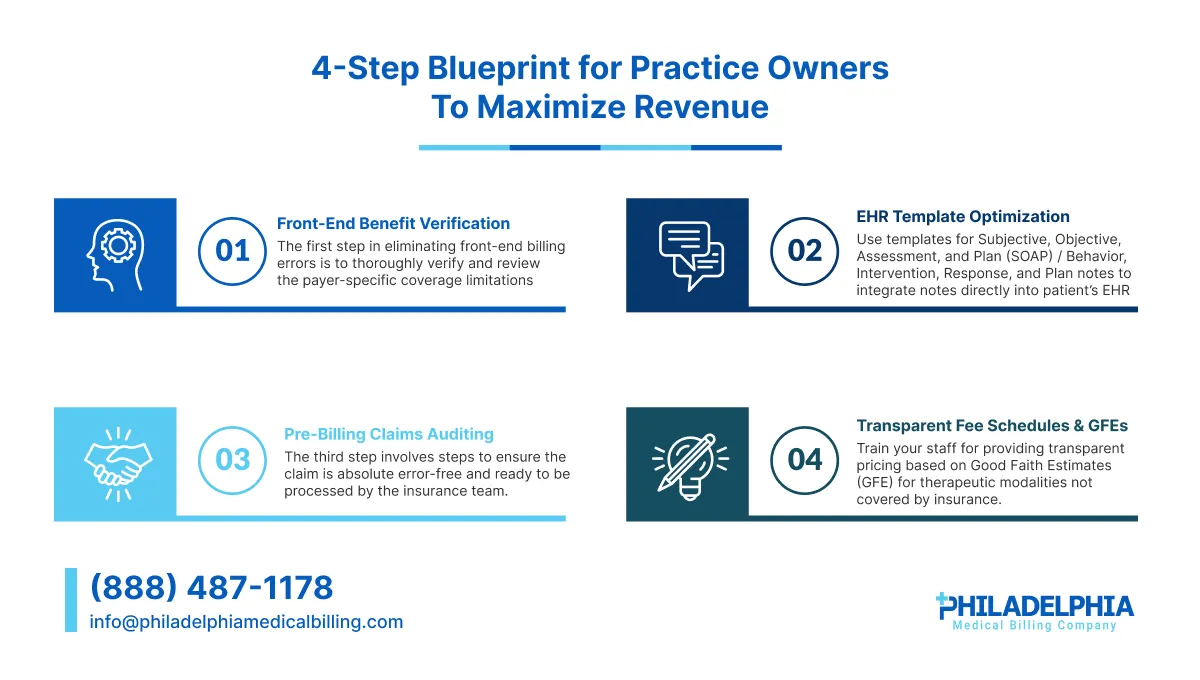
1.Front-End Benefit Verification
The first step in eliminating front-end billing errors is to thoroughly verify and review the payer-specific coverage limitations, deductibles, coordination of benefits, prior authorization, time-based coding restrictions and maximum allowable charge units per session to align multi-modal care plans with payer policies.
2.EHR Template Optimization
Use templates for Subjective, Objective, Assessment, and Plan (SOAP) / Behavior, Intervention, Response, and Plan notes to integrate notes directly into patient’s EHR detailing start/stop times, modality intervention or shift, and medical necessity details to make the billing process seamless.
3.Pre-Billing Claims Auditing
The third step involves steps to ensure the claim is absolute error-free and ready to be processed by the insurance team. Your staff must perform claim scrubbing to check the code aligns with the services performed, allowed session duration, prior authorization requirements and payer-specific submission timeline to ensure the claim is audit-proof.
4.Transparent Fee Schedules & GFEs
Train your staff for providing transparent pricing based on Good Faith Estimates (GFE) for therapeutic modalities not covered by insurance. For non-covered therapy services, send pricing estimates on mobile through email and texts to promote transparency and trust between your practice and patients.
This four step framework ensures practices deliver excellent care services and protect their earning without sacrificing the quality.
Conclusion : Aligning Clinical Excellence with Financial Health
Mastering the therapeutic modalities isn’t a choice, it’s necessary for keeping your practice running smoothly. When your practice’s financial goals are aligned with clinical outcomes, the end beneficiary are both you and your patients. When you accurately establish anchor modality with secondary modality, your documentation ensures payers understand the reasons behind the medical decision making.
Additionally, following a four step billing framework systematically ensuring insurance verification, integrating SOAP/BIRP templates into EHR, pre-claim scrubbing, and offering good faith estimates ensures your practice’s financial health remains stable while also maintaining patient trust.
Are you ready to optimize your medical billing operations? Contact Philadelphia Medical Billing to audit your revenue cycle and stop leakages all at once. Get a free billing audit today.