
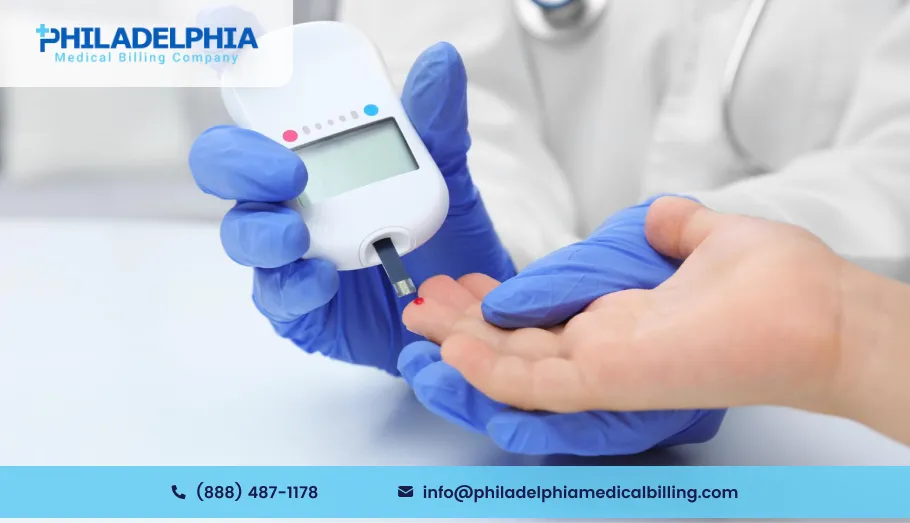
Clinical charting often contains the phrases like “poorly managed T2DM”. Even with the accurate coding for this condition these claims face rejections, denials and missed Risk Adjustment Factor (RAF) scores. Under the new ICD-10-CM classification protocols, the term uncontrolled is invalid and the symptoms of the diabetes must use precise clinical manifestations like Hyperglycemia or Hypoglycemia.
The use of invalid medical descriptors expose medical practices to clawbacks and compliance issues that result in fines and penalties. This blog highlights the five pitfalls for type 2 diabetes uncontrolled ICD-10 scenarios and how you can ensure clinical documentation improvement (CDI) to optimize compliance and high RAF scores.
Pitfall #1: Relying on Unspecified Code E11.9 for High A1C Patients
While treating patients with type 2 diabetes, it is important that clinical chart must be documented using recent results from HbA1c to properly document glycemic results:
The Clinical Error
The most frequent billing error comes from defaulting to ICD E11.9 (Type 2 diabetes mellitus without complications), even when the patient lab reports showing higher HbA1c levels above 8 or so. Appending E11.9 for such cases undermines the risk adjustment pertaining to high glucose levels, and increases the chances of claim rejection.
The Documentation Fix
When lab findings clearly report A1c +8%, this must be logged in the clinical statements like “Type 2 diabetes with hyperglycemia” to support your medical rationale with the accurate severity of the disease.
Coding Specificity: E11.9 vs E11.65
When evaluating E11.9 vs E11.65,your clinical charts must explicitly note the specificity for elevated glucose levels based on the latest lab reports. By doing this, medical coders can assign ICD-10 code E11.65 (Type 2 diabetes mellitus with hyperglycemia), accurately presenting the patient symptoms and supporting medical decision making.
Pitfall #2: Confusing Hyperglycemia (E11.65) with Hypoglycemia (E11.649)
Confusing hyperglycemia with hypoglycemia also becomes a headaches, leading to erroneous coding, billing and modifier use:
The Clinical Error
Another common mistake is mixing the episodes of hyperglycemia with hypoglycemia in documentation or using them interchangeably. Doing this blurs the line between both extreme symptoms into a generic phrase. This leads to inaccurate uncontrolled diabetic blood sugar coding, resulting in a faulty clinical picture and risk evaluation scores.
Clarifying Coding Boundaries
Establishing clear coding and documentation boundaries with accurate progress notes is essential for error-free billing. Here’s how you should append codes based on the high or low glucose levels:
Hyperglycemia
Use ICD E11.65 when random, fasting and A1c levels stay above established levels as indicated in the lab findings.
Hypoglycemia
Apply E11.649 code when patient experiences acute low glucose levels but didn’t experience coma, or unconsciousness. Whereas, E11.641 is reserved for hypoglycemic episodes with coma, unconsciousness, whether briefly or prolonged.
Pro Tip for Brittle Diabetes
If the patient is experiencing hypo and hyperglycemia both like alternating between very low glycemic levels and very high, providers must use both codes E11.65 and E11.649 to document complications of brittle diabetes.
Pitfall #3: Omitting Essential Combination Codes & Linkage Language
Failing to create a link between diabetes and other related diseases can hinder the reimbursement process and introduce errors in clinical documentation.
The Clinical Error
Clinical charting often falls short of listing comorbid conditions as combined. Separating diabetes-induced neuropathy, chronic kidney disease (CKD), or retinopathy prevents practices to use “With” rules of ICD-10 coding. This results in documentation error and increased healthcare costs on patients.
The Documentation Fix
To apply a proper documentation fix to increase compliance and risk adjustments, provider notes must explicitly document the clear link between these conditions. Use the terms like “due to”, secondary to” or “diabetic”. By using these terms in charting, coders can easily assign ICD-10 combination coding logic to align billing practices with payer guidelines.
Clinical Example
To treat a case of diabetes with nephropathy, instead of documenting Chronic Kidney Disease Stage-3 (CKD), use this phrase “Type 2 diabetes with chronic kidney disease, stage 3” and add ICD10 (E11.22 + N18.30). Doing this ensures true complexity of the condition is captured, helping you maintain error-less documentation.
Pitfall #4: Missing Long-Term Medication Use Z-Codes
Failure to document recommended oral or injectable therapies is a critical oversight that can disturb the link between the disease and its therapeutic intervention.
The Clinical Error
Documenting the treatment of poorly controlled Type-2 Diabetes without mentioning which therapy either oral, lifestyle modification or injectable directly impacts the quality metrics, RAF scores, etc.
The Documentation Fix
Type 2 Diabetes Uncontrolled ICD 10 coding is incomplete if it lacks the Z-code linkage. Pair the primary ICD-10 type 2 diabetes code with secondary Z-code to specify medication management in use. These are some of the commonly used Z-codes for oral and injectable anti-diabetic therapeutic interventions:
Z79.4 long term insulin code
For patients on chronic insulin therapy.
Z79.84
For long-term use of oral hypoglycemic drugs like Metformin, Sulfonylureas, DPP4 inhibitor, etc
Z79.85
Used for non-insulin peptide-based antidiabetic injections like GLP-1 agonists.
Clinical Impact
Listing the therapeutic interventions and therapies to control diabetes strengthen the compliance with payer reimbursement policies. It helps you validate the accurate level of care rendered to manage and control complications.
Pitfall #5: Treating “Uncontrolled” as a Standalone Diagnosis in Charting
Standalone diagnosis create documentation gap that trigger claim denials:
The Clinical Error
Listing “Uncontrolled T2DM” as a single standalone medical assessment without providing any clinical context widens the documentation gap in your practice. Any chart audit for diabetes management coding with vague entries lacking required details lowers RAF scores.
The Documentation Fix
Your clinical documentation must include three detailed aspects of poorly controlled type 2 diabetes mellitus:
1-Specific Acuity
Charting must explicitly document medical conditions such as Type 2 Diabetes with Hypo or Hyperglycemia.
2-Contributing Factors
Documentation must include the real root-cause of poor control like non-adherence with recommended medication, poor diet control, or medication inefficacy, etc.
3-Treatment Modifications
Interventional steps must be mentioned in the assessment plan such adding sulfonylurea with metformin, or dosage titration of basal insulin, or adding GLP-1 agonist.
Clinical Impact
When you take above-mentioned steps like adding specific acuity, cause and treatment modalities, you ensure the claim stays bullet-proof against rigorous payer scrutiny.
Conclusion
Precision in type 2 diabetes uncontrolled ICD-10 coding ensures your clinical documentation safeguards your earned revenue. Taking the clinical steps we mentioned in the guide help you prevent retroactive clawbacks, avoid automated denials and improve clinical outcomes.
Providers can easily avoid the costly pitfalls by ditching the vague clinical terms, use appropriate linkage language and add Z-modifiers to capture therapeutic interventions. If your primary care practice is suffering from all of these unresolved issues, consider outsourcing patient billing to a reputable company like Philadelphia Medical Billing to improve the compliance with state and federal insurance networks. Get your free medical billing audit to spot the hidden leakages.